
Buying a home in Gurgaon is exciting, but there’s one part of the process that catches most buyers off guard — stamp duty and registration. These aren’t small charges you can brush aside while budgeting. Get the numbers wrong, and your dream home purchase can suddenly cost several lakhs more than you planned.
Whether you’re eyeing residential projects in Gurgaon or scouting commercial projects in Gurgaon for investment, understanding stamp duty and registration charges is just as important as picking the right location or builder. This guide breaks it all down in plain language — what it is, how much you’ll actually pay, and how the registration process works from start to finish.
What is Stamp Duty?
Think of stamp duty as a tax the government charges whenever a property changes hands. It isn’t optional — it’s a legal requirement under the Indian Stamp Act, 1899. Once you pay it, your sale deed becomes a valid, legally recognised document that proves you own the property.
Here’s the part most first-time buyers don’t realise: without paying stamp duty, your sale deed carries no legal weight in court. So even if you’ve paid the builder or seller in full, you aren’t the legal owner until the property is stamped and registered in your name.
Stamp duty rates also aren’t uniform across India — every state fixes its own rates. That’s why the exact same apartment would attract a different stamp duty bill in Delhi compared to Gurgaon or Mumbai.
What is Stamp Duty in Gurgaon?
Since Gurgaon falls under Haryana, stamp duty here follows Haryana’s stamp duty rules. Gurgaon being one of the biggest corporate and real estate hubs in the Delhi NCR region, property transactions here run into thousands of crores every year, making stamp duty a significant revenue source for the state.
Stamp duty in Gurgaon is charged as a percentage of the property’s value. What surprises a lot of buyers is that the rate isn’t fixed — it depends on who is registering the property. A man, a woman, and a couple registering the exact same flat jointly will end up paying three different amounts.
Stamp Duty Rates in Haryana 2026
Here’s the current break-up of stamp duty rates in Haryana for 2026:
Within municipal limits (most of Gurgaon falls here):
- Male buyer: 7%
- Female buyer: 5%
- Joint ownership (male + female): 6%
Outside municipal limits (rural areas):
- Male buyer: 5%
- Female buyer: 3%
- Joint ownership (male + female): 4%
Notice that 2% gap for women buyers? Haryana offers this concession specifically to encourage more property ownership among women. If you’re buying with your spouse, registering the flat fully or partly in your wife’s name can genuinely bring the cost down.
Here’s what that looks like on a ₹1 crore flat in Gurgaon:
| Buyer Type | Stamp Duty Rate | Amount Payable |
| Male | 7% | ₹7,00,000 |
| Female | 5% | ₹5,00,000 |
| Joint (Male + Female) | 6% | ₹6,00,000 |
That’s a straight saving of ₹2,00,000 just by deciding how the property gets registered.
How is Stamp Duty Calculated?
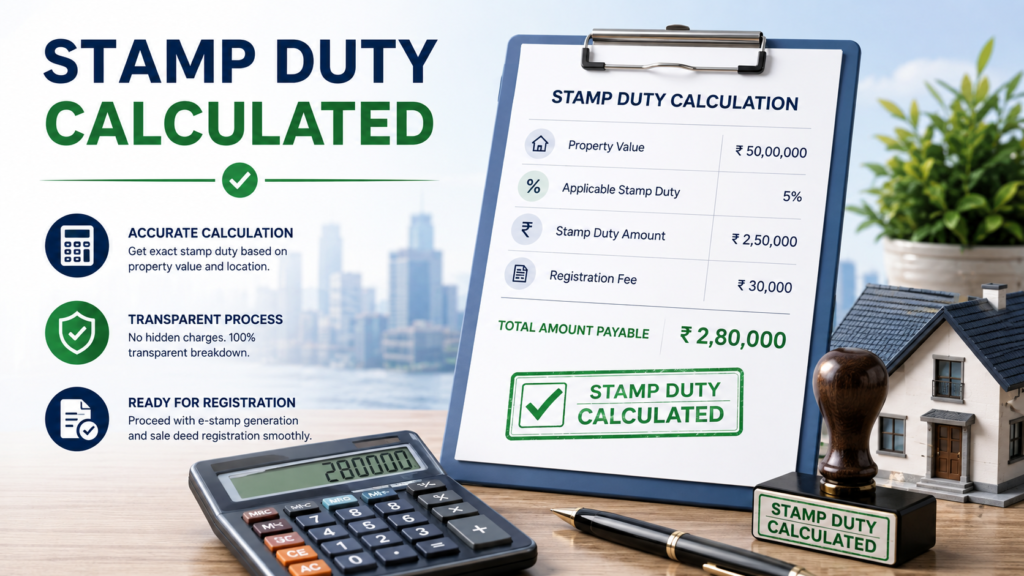
Stamp duty isn’t calculated on whatever figure you and the seller privately agree upon. It’s charged on whichever is higher — the actual transaction value or the government’s circle rate (also called the collector rate) for that locality.
So if you’re buying a flat in a Gurgaon sector for ₹85 lakh, but the circle rate for that sector values the property at ₹95 lakh, stamp duty gets calculated on ₹95 lakh, not ₹85 lakh. It’s worth checking the current circle rate for your sector before finalising a deal — especially in sectors where rates have recently been revised upward.
Property Registration Charges in Gurgaon
Registration charges are separate from stamp duty and cover the cost of officially recording your sale deed at the Sub-Registrar’s office. Unlike stamp duty, Haryana’s registration fee follows a slab system rather than a flat percentage:
| Property Value | Registration Fee |
| Up to ₹50,000 | ₹100 |
| ₹50,001 – ₹5,00,000 | ₹1,000 |
| ₹5,00,001 – ₹10,00,000 | ₹5,000 |
| ₹10,00,001 – ₹20,00,000 | ₹10,000 |
| ₹20,00,001 – ₹25,00,000 | ₹12,500 |
| Above ₹90,00,000 | Capped at ₹50,000 |
So no matter how expensive the property, registration fees in Haryana never cross ₹50,000. It’s stamp duty, not the registration fee, that scales up with property value.
Factors That Affect Your Stamp Duty and Registration Costs
A few things decide exactly how much you end up paying:
- Type of deed — A straightforward sale deed attracts full stamp duty, but gift deeds to blood relatives are usually charged at a lower rate, and lease deeds are calculated differently based on the annual rent and lease period.
- Location — Properties within municipal limits attract higher rates than those in rural or outlying parts of Haryana.
- Ownership structure — As covered above, whether the property is registered in a male name, female name, or jointly changes the applicable rate.
- Property category — Residential, commercial, and agricultural properties are all charged the same percentage in Haryana, but the underlying circle rate differs by category and location.
Knowing these factors upfront helps you plan your budget more accurately instead of being caught off guard at the Sub-Registrar’s office.
A Quick Word on Circle Rates
Circle rates in Gurgaon vary quite a bit from sector to sector, and even within the same sector depending on whether it’s a plotted area, group housing, or a commercial belt. Before finalising any deal — residential or commercial — it’s worth checking the latest circle rate for that specific sector. Since stamp duty always defaults to the higher of the circle rate or the agreement value, this one check can save you from underestimating your total cost.
Documents Required for Property Registration in Gurgaon
Before heading to the Sub-Registrar’s office, keep these ready:
- Sale deed, drafted and ready for signing
- ID proof of both buyer and seller (Aadhaar, PAN, passport)
- PAN card of both parties
- Passport-size photographs
- Property card and previous title documents
- No Objection Certificate (NOC), where applicable
- Payment receipts for stamp duty and registration fee
- Two witnesses carrying valid ID proof
If you’re buying into an under-construction project — common with both residential projects in Gurgaon and commercial projects in Gurgaon — you’ll also need the builder-buyer agreement and the payment schedule.
Step-by-Step Registration Process in Gurgaon
Haryana has moved almost entirely online, which makes the process a lot smoother than it used to be:
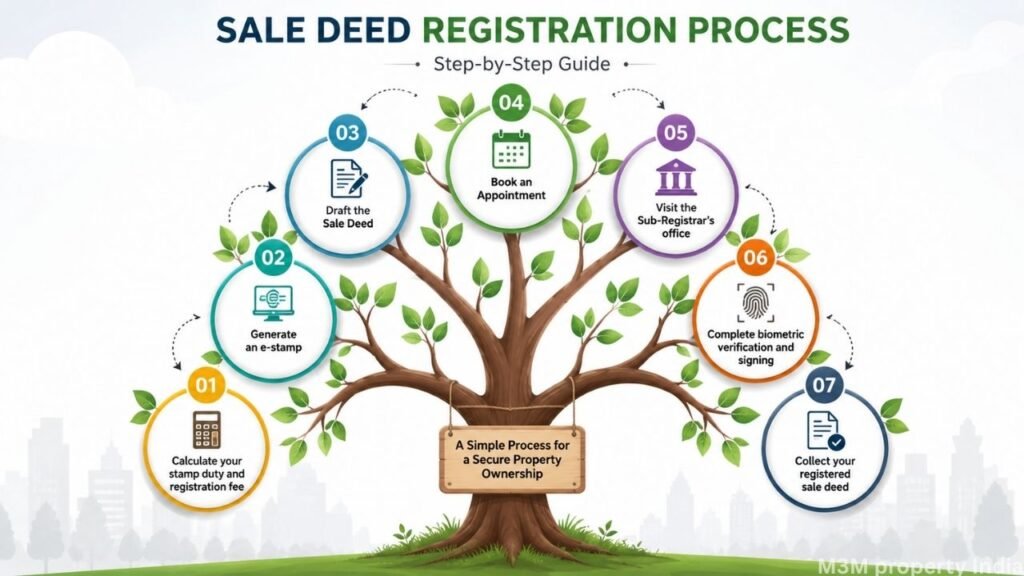
- Calculate your stamp duty and registration fee using the Haryana e-GRAS portal, or with help from your property consultant.
- Generate an e-stamp by paying online through e-GRAS (egrashry.nic.in).
- Draft the sale deed with all property and party details filled in correctly.
- Book an appointment through the Haryana NGDRS (National Generic Document Registration System) portal for your local Sub-Registrar office.
- Visit the Sub-Registrar’s office on the appointed date with both parties, witnesses, and all documents in hand.
- Complete biometric verification and signing at the office — this finalises your sale deed registration.
- Collect your registered sale deed, which now serves as your legal proof of ownership.
If your paperwork is in order, the entire in-person process usually wraps up within a single day.
Stamp Duty on Residential and Commercial Projects in Gurgaon
A question that comes up often: is stamp duty different for residential projects in Gurgaon versus commercial projects in Gurgaon? The short answer — no. Haryana applies the same stamp duty percentage regardless of whether you’re registering a residential flat, an independent floor, or a commercial shop or office unit.
What does change is the circle rate. Commercial circle rates in a given sector are usually higher than residential ones, since commercial space typically commands a higher market value per square foot. So while the percentage stays identical, the final stamp duty amount on a commercial unit often works out higher simply because the base value is higher.
Tax Benefits on Stamp Duty and Registration Charges
Here’s some good news for buyers — stamp duty and registration charges qualify for a tax deduction under Section 80C of the Income Tax Act. The combined 80C deduction limit is ₹1.5 lakh per financial year, shared with other investments like PF and life insurance premiums. This benefit applies only in the year you actually pay the charges, and only for residential property.
Penalty for Delay in Registration
Under the Registration Act, 1908, a document must be presented for registration within four months of its execution. Miss that window, and the registering authority may still allow delayed registration, but with a penalty of up to 10% of the registration fee. It’s best not to sit on your paperwork once the sale deed is signed.3
Circle Rate in Gurgaon Sector and Colony Wise
In this Section we see the projects Circle Rate in Gurgaon Sector wise.
Circle Rate in Old Gurgaon / HUDA Sectors
| Sector | Circle Rate (₹/sq ft) |
| 1, 3, 3A, 6, 12, 27, 104–106 & 109–115 | 52,900 |
| 2, 5, 7, 12A, 21, 22A, 23–23A | 55,300 |
| 4 | 53,000 |
| 17 (P), 22 | 57,700 |
| 38 | 64,900 |
| 16–17, 28, 40 | 71,600 |
| 42 | 72,700 |
| 14, 15 | 74,800 |
| 43 | 79,300 |
| DLF Old Colony | 79,300 |
| DLF Qutub Enclave Phase 2 | 88,100 |
| Palam Vihar (Sushant Lok) | 64,000 |
| New Palam Vihar | 39,000 |
Circle Rate in New Gurgaon / Growth Corridors Post April 2026 revision (₹ per sq yd)
| Location | Revised | RateHike |
| Dwarka Expressway (Sec 104–115) — Residential | 2,24,796 | 30% |
| Dwarka Expressway (Sec 104–115) — Commercial | 2,04,750 | 75% |
| SPR — Sectors 63, 63A, 64, 67 | 84,825 | 45% |
| SPR — Sectors 62, 65, 66, 69–72 | 91,000 | 30% |
| Golf Course Extension Road | 91,000 | 30% |
| DLF Phase 5 | 1,85,000 | 75% |
| Sector 25 (Commercial) | 2,43,941 | 75% |
| Sohna (Group Housing) | 63,000 | 10% |
| IMT Manesar (Industrial) | – | 30% |
Circle Rate in Premium colonies & top rankings — FY 2026–27 (₹ per sq yd)
| Location | Residential | Commercial |
| DLF Phase II | 2,17,000 | – |
| DLF Colony (Old) | 1,04,900 | 2,30,100 |
| New Colony | 97,000 | 1,39,800 |
| Palam Vihar | 92,000 | 3,12,500 |
| Shivaji Nagar | 82,300 | 87,200 |
| Jacubpura | 77,600 | 1,66,300 |
| Sadar Bazar–Bhuteshwar Mandir | – | 2,84,000 |
| Civil Line–Jail Road | – | 2,82,300 |
Final Thoughts
Stamp duty and registration charges usually add another 7-8% to your total property cost in Gurgaon, so it isn’t something to work out at the last minute. Whether you’re buying your first home, investing in one of the many residential projects in Gurgaon, or picking up space in a commercial development, factor these charges in right from the start. A little planning here goes a long way toward a smooth, surprise-free registration day.
FAQs on Stamp Duty and Registration Charges in Gurgaon
Is stamp duty different for men and women in Gurgaon?
Yes. Women get a 2% concession compared to men within municipal limits — 5% versus 7%.
Can I pay stamp duty and registration charges online?
Yes, through the Haryana e-GRAS portal, using net banking, debit card, or credit card. The e-stamp is generated instantly after payment.
Is stamp duty calculated on the agreement value or the circle rate?
Whichever is higher. If your agreement value is lower than the circle rate, stamp duty is still calculated on the circle rate.
Do commercial projects in Gurgaon attract higher stamp duty than residential ones?
The percentage rate stays the same, but since commercial circle rates tend to be higher, the final stamp duty amount usually works out to be more.
What happens if I don't register my property?
Without registration, your ownership has no legal standing, and you’ll run into trouble later if you try to sell, transfer, or take a loan against the property.